How to Build a Bedtime Story Routine That Teaches English
By The Dobi Apps Team · Published 2026-09-16 · Originally published at dobiapps.com
A 2019 study found children read to daily hear 1.4 million more words by age 5. Dialogic reading, timing, and audio choices make bedtime stories teach English.
In short: A bedtime story routine teaches English through four things: reading aloud often enough that vocabulary compounds over years, asking open-ended questions instead of only narrating, picking a story at a level a child can mostly follow, and finishing with audio rather than a screen so the routine does not work against the sleep it is supposed to protect.

How Much Does Reading Aloud at Bedtime Build a Child’s English Vocabulary?
Reading aloud daily builds a large, compounding vocabulary advantage. A 2019 study estimated that a child read to once a day hears 296,660 more words by kindergarten than a child never read to, and a child read to five times a day hears 1,483,300 more words, a gap the study’s authors call “striking” (Logan, Justice, Yumuş & Chaparro-Moreno, 2019).
1.4M+ — more words heard by age 5 by children read to 5 times a day, compared with children never read to at home
Source: Logan et al., 2019, Journal of Developmental & Behavioral Pediatrics
The study reached this estimate by transcribing 60 commonly read children’s books and multiplying their median word counts by how often nationally representative families report reading at home. The gap is cumulative, not a one-time boost: it grows every year a child is read to, from birth through kindergarten entry.
| Reading frequency | Cumulative words heard by age 5 |
|---|---|
| Never | 4,662 |
| 1 to 2 times per week | 63,570 |
| 3 to 5 times per week | 169,520 |
| Daily (1 book) | 296,660 |
| Multiple books per day (5 books) | 1,483,300 |
Lead author Jessica Logan noted that “this isn’t about everyday communication. The words kids hear in books are going to be much more complex, difficult words than they hear just talking to their parents” (Ohio State University, 2019). For a child learning English specifically, that density of unusual words is the point: it is the same comprehensible input that makes reading and listening practice build fluency at any age, arriving earlier and in a warmer setting than a classroom can provide.
What Is Dialogic Reading, and How Do You Ask Questions While You Read?
Dialogic reading means the adult stops narrating and starts asking questions, turning the child into the storyteller and the adult into an active listener. Developed by Grover Whitehurst in 1988, it is built around two prompt sequences: PEER (Prompt, Evaluate, Expand, Repeat) for guiding a single exchange, and CROWD for choosing what to ask about the page in front of you.
A 2022 systematic review of 46 studies covering 2,693 children aged 2 to 9 describes dialogic reading as encouraging “the child to become the storyteller and the adult an active listener who provides assistance as required, facilitates, expands and responds to the child’s verbalisations” (Pillinger & Vardy, 2022). The CROWD prompts give a parent a concrete way to do that instead of just reading the page as written.
| CROWD prompt | What it asks |
|---|---|
| Completion | Pause at the end of a sentence and let the child supply the last word |
| Recall | Ask the child to recall what happened earlier in the story |
| Open-ended | Ask a question with no single right answer, often about an illustration |
| Wh- questions | Ask what, where, when, or why about the story |
| Distancing | Connect something in the story to the child’s own life |
The same review is candid about the evidence’s limits: only 8 of the 46 studies calculated an effect size at all, and the review concludes that “the educational value of the Whitehurst et al. (1988) programme is modest,” with effects that vary by child age rather than applying evenly. Dialogic reading is worth doing because it costs nothing and has never been shown to hurt, not because its effect size is settled science.
Does It Matter What Time of Night You Read the Story?
Reading earlier in the evening produces larger overnight vocabulary gains than reading right at bedtime. A 2021 study had 237 children aged 5 to 7 learn 12 novel words from an alien-adventure story, with parents reading it either at bedtime or 3 to 5 hours before bedtime, then tested comprehension the next morning.
“Overnight gains in comprehension were larger if the story was read 3 to 5 hours before bedtime rather than at bedtime,” the researchers reported (Henderson, van Rijn, James, Walker, Knowland & Gaskell, 2021), a result that ran counter to their own expectation that learning closer to sleep would help retention more.
That does not mean a bedtime story is wasted. It means a routine that adds a second, earlier story session, right after dinner or during bath time, gives new words a better shot at sticking than packing every exposure into the last few minutes before lights out. The bedtime story itself still does the job the word-gap research above measures: consistency of exposure across months and years, not the timing of any single session, is what produces most of the vocabulary gap.
Is an Audiobook Safer for Sleep Than a Screen at Bedtime?
Audio protects the sleep a bedtime routine is supposed to build, in a way video does not. A 2018 study of preschoolers aged 3 to 5 found that one hour of evening bright light exposure left melatonin levels roughly 88% lower than in a dim-light condition, with suppression persisting for at least 50 minutes after the light was switched off (Akacem, Wright & LeBourgeois, 2018). A lit screen held close to a child’s face at bedtime is a source of exactly that kind of evening light exposure.
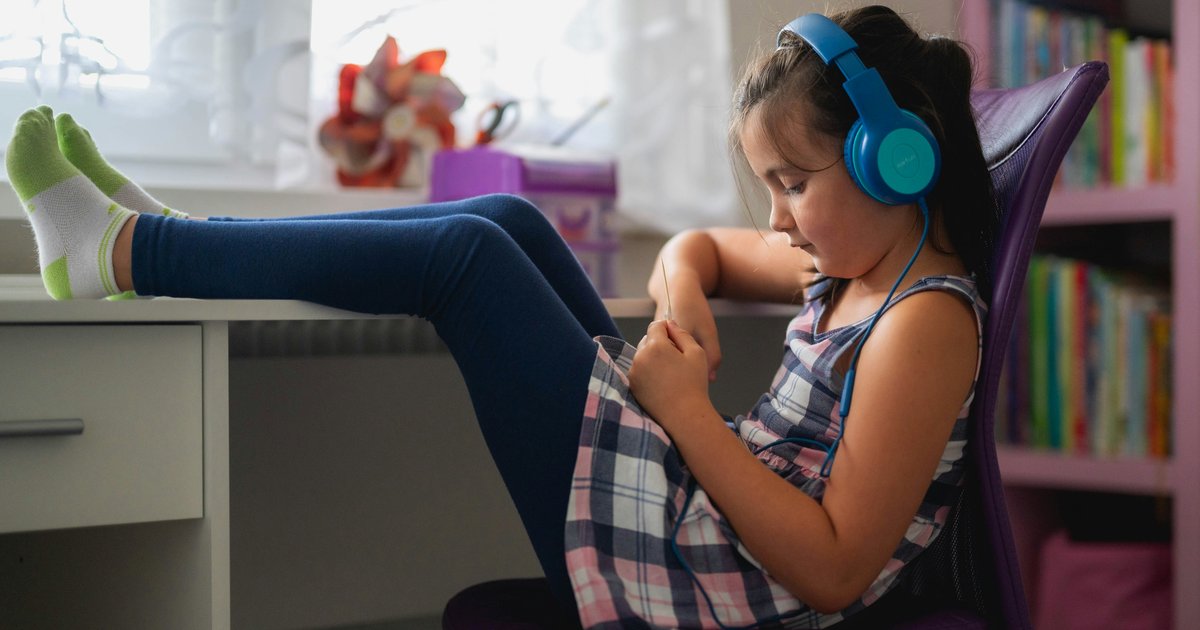
The American Academy of Pediatrics has moved away from a blanket screen-time limit, stating there “isn’t enough evidence demonstrating a benefit from specific screen time limitation guidelines” (American Academy of Pediatrics). It asks parents to weigh what content displaces instead, one of its “5 C’s” of media guidance: Child, Content, Calm, Crowding out, and Communication. The Sleep Foundation’s own guidance names a screen-free routine in the hour before bed as the practice that most reliably protects sleep, recommending “reading, coloring, painting, or stretching” instead (SleepFoundation.org).
Choosing audio does not mean giving up story variety. A 2024 survey of more than 37,000 children and young people aged 8 to 18 found 42.3% enjoy listening to audio in their free time, versus 34.6% for reading, the first year listening has outpaced reading in that survey (National Literacy Trust, 2024). Dobi Apps’ Audiobook fits the last slot in a bedtime routine: leveled audio from A1 to C2 with no video component, leaving Storybook and its picture books, comics, and games for the earlier, more screen-tolerant part of the evening. Video is not automatically the stronger option even earlier in the day: a study covered in whether subtitles help children learn English vocabulary found primary-age children got no measurable benefit from captioned video at all.
How Do You Choose an English Story at the Right Level for a Child?
Pick a story where a child can follow the plot from pictures and repetition even before every word is familiar. That is the same comprehensible input principle that governs story selection for any English learner: too many unfamiliar words at once removes the context a child needs to guess the rest.
For a child just starting out, board books and picture books with one sentence per page and heavy repetition work best, the same simple, repetitive text that let researchers estimate word counts precisely in the vocabulary studies above. As a child’s spoken English grows, short chapter books with occasional illustrations extend the same extensive-reading approach that works for any English learner, just with content written for a child’s interests rather than an adult’s.
An older or more reluctant reader does not have to move to plain prose right away. Comics and graphic novels pair text with pictures in a way that keeps the same contextual guessing available at a more advanced reading level, which makes them a reasonable bridge for a child who has outgrown picture books but finds chapter books intimidating. Storybook organizes its library of more than 1,000,000 books, comics, audiobooks, and games by level, which removes the guesswork of matching a specific title to where a specific child actually is.
How Long and How Often Should the Bedtime English Story Routine Be?
Short and frequent beats long and occasional. The dialogic reading studies reviewed by Pillinger and Vardy most commonly ran sessions of 5 to 15 minutes a day, for about 6 to 8 weeks, a dosage well within a normal bedtime story’s length (Pillinger & Vardy, 2022). The word-gap study above reaches the same conclusion from a completely different angle: it is the daily habit, not any single long session, that produces a gap approaching 1.5 million words by age 5.
Building that daily habit is the same problem as building any other daily English learning habit: a fixed cue, the same point in the evening routine every night, matters more than the length of any one session. A missed night here and there does not undo the routine; what resets it is letting the gap stretch to several nights in a row.
Rereading the same bedtime book on repeated nights is not wasted repetition either. The same mechanism that makes rereading build fluency for older learners applies to a child hearing a favorite book for the fifth time: word recognition becomes automatic, and a child who already knows what happens next has spare attention to notice a sentence pattern or a word they glossed over the first time. A rotation of a few favorites, read on repeat, does more for a young learner than a constant supply of new titles never revisited.
Frequently Asked Questions
Is it too late to start a bedtime story routine with an older child?
No. The read-aloud research behind the word gap covers the first five years, but dialogic reading studies reviewed in 2022 included children up to age 9, and vocabulary from context keeps working at any age. Starting later means starting with a harder book and older habits to build, not a closed window.
Should a parent translate English words into a child’s first language while reading?
Occasional translation of a single blocking word is fine, but dialogic reading’s own techniques, asking the child to complete a sentence or recall what just happened, work in English and keep the child working out meaning from pictures and repetition rather than waiting for a translation every time.
Can an audiobook replace a parent reading aloud?
Not for the questioning part. Dialogic reading’s benefit comes from an adult pausing to ask questions and respond to a child’s answers, which a recording cannot do. An audiobook is a strong choice for the nights a parent cannot read aloud, or for rereads once a child already knows the story.
Sources
- When Children Are Not Read to at Home: The Million Word Gap
- A ‘million word gap’ for children who aren’t read to at home
- The story so far: A systematic review of the dialogic reading literature
- Timing storytime to maximize children’s ability to retain new vocabulary
- Sensitivity of the circadian system to evening bright light in preschool-age children
- How Does Blue Light Affect Children’s Sleep?
- Kids & Screen Time: How to Use the 5 C’s of Media Guidance
- Screen Time Guidelines
- Children and young people’s listening in 2024
Related articles
- How to Learn English Effectively Through Stories
- Comprehensible Input: Find Your Right English Level
- Does Reading While Listening to Audiobooks Improve English?
- Does Rereading a Book Build English Fluency?
- How to Build an English Learning Habit That Lasts
📖 Read the original article on the Dobi Apps blog: How to Build a Bedtime Story Routine That Teaches English
Learn English with the Dobi Apps: Audiobook · Storybook · All articles · ← Dobi Apps